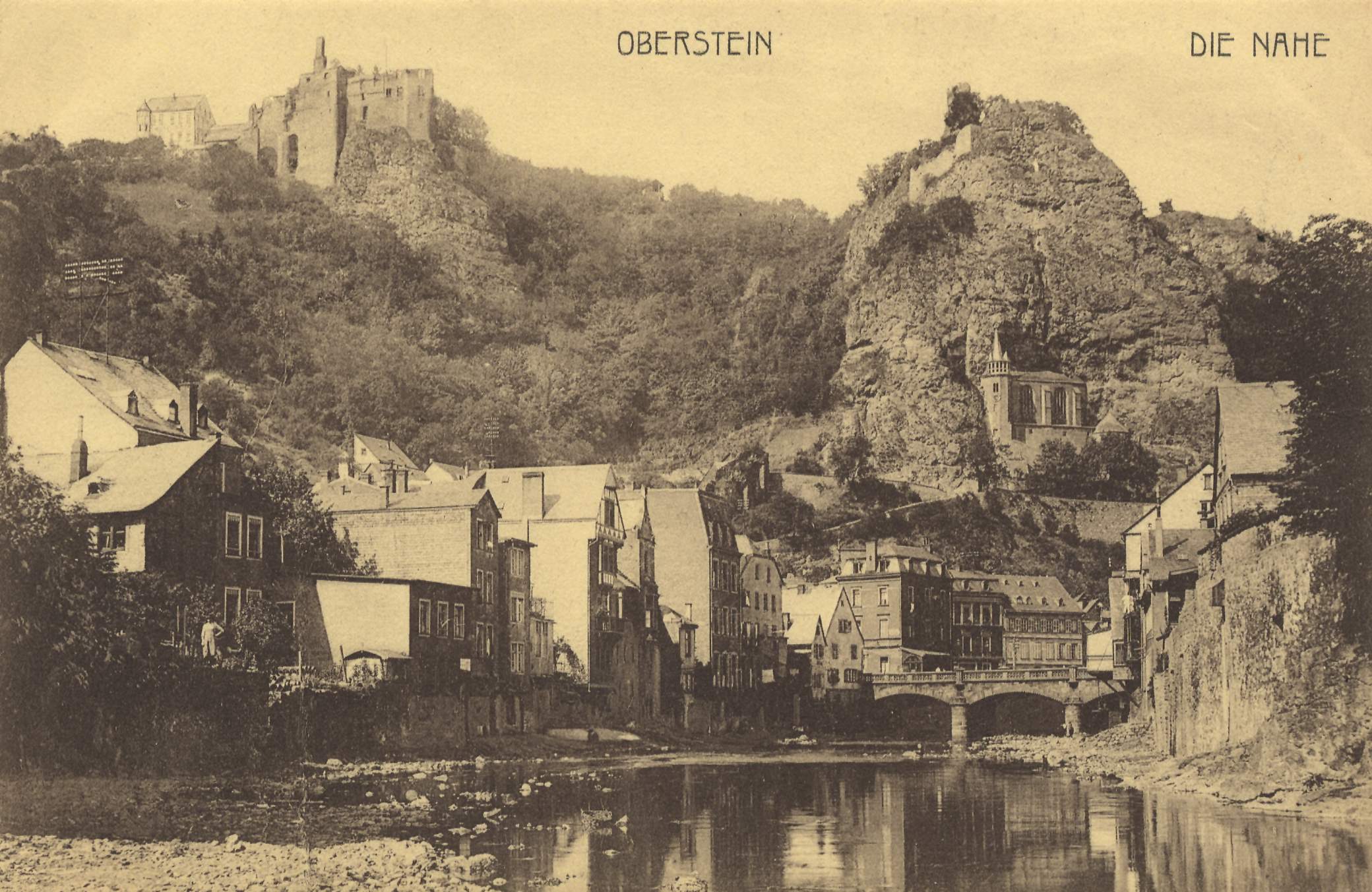
Ask a coloured-stone dealer in Bangkok, Jaipur or Hong Kong where the world's finest gems are cut, and sooner or later one name comes up: Idar-Oberstein. It is a town of about 30,000 people in the Hunsrück hills of south-west Germany, and the mines that made it famous closed long ago. Yet for more than five centuries rough from all over the world has come here to leave as finished gems, carvings and jewellery.
I work in Idar-Oberstein every day, and its story still fascinates me. It is a story of local agate, water power and hard physical labour. It is also about emigrants who found new rough on the other side of the Atlantic, and about cutters, scientists and traders who reinvented the town every time its raw material ran out.
Agate in the hills: where it all began
The first stones cut here were local. Agate, jasper and amethyst formed in the volcanic rocks of the region, and farmers and miners dug them out of the hills around Idar and Oberstein. Gem processing in the valley goes back to at least the 15th century, and the first agate grinding mill in Oberstein is documented in 1531.
The trade itself dates its birth to 1497. In 1997 the journal of the German Gemmological Association marked the anniversary with a history titled “500 Years of the Gemstone Region Idar-Oberstein (1497–1997)”. By the early 17th century, agate working had grown into an industry of real importance.
The most famous local source was the Steinkaulenberg, a hill above Idar. Agate and jasper were mined there until the 1870s, and its old tunnels are now open to visitors.
Water, sandstone and cutters lying on their bellies
What turned stones into an industry was water. The Idarbach and the Nahe drove water wheels, and the wheels turned large grinding wheels of sandstone. The cutters spent much of the day lying almost flat on tilting wooden benches, the Kippstühle, pressing the stone against the turning wheel with their body weight. It was wet, cold and exhausting work.
At its height the region had 183 of these grinding mills, 56 of them on the Idarbach alone. A German encyclopaedia of 1888 counted 153 agate cutting works with 1,400 cutters. The mills peaked in the 19th century; in the first three decades of the 20th century they closed one after another.
One survived. The Historische Weiherschleife between Idar and Tiefenstein worked, with interruptions, until 1945 and was restored in 1953/54 as the last mill of its kind. Today it still demonstrates the old technique on its sandstone wheels, and it is the best place to understand how hard this craft once was.
The water also explains the town's double identity. Cutters settled along the Idarbach in Idar. From around 1660, goldsmiths settled on the Oberstein side of the Nahe, because agate set in metal sold better. That is where the jewellery factories later grew.
When the local stone ran out: the Brazil connection
From the 18th century onwards the local deposits dwindled, and by the 1870s mining in the hills had stopped. Long before that, poverty and hunger had driven many Hunsrück families to emigrate, a good number of them to South America.
Some of these emigrants knew agate from home, and they recognised it in the riverbeds and fields of their new country. In 1827 they discovered what became the world's most important agate deposit, in Rio Grande do Sul in southern Brazil; the same agate belt extends into neighbouring Uruguay. In 1834 the first South American agate arrived in Idar. Ships that would otherwise have crossed the Atlantic half-empty carried the nodules home as ballast.
The new material changed everything. It came in large volumes, and its fine, very even banding was ideal for cameos and engraved gems. Since then, the ties between Idar-Oberstein and Brazil have shaped the trade.
From agate to the world's gemstones
Idar-Oberstein never survived on one product for long. Each time a market matured, the town moved on to the next, more demanding one.
Colour. After 1813, local cutters found that heat changes the colour of chalcedony. In 1819 an Idar merchant brought home the secret of dyeing agate black, learnt from a stone cutter in Rome. The same year, a scientific journal in Edinburgh already published an account of how agates are coloured. Dyeing turned plain grey material into the black, blue, green and red agates that made Idar-Oberstein a household name.
Carving and engraving. The even banding of South American agate made the town a centre for cameos and intaglios. That carving tradition lives on today in sculptures cut from a single crystal.
Faceting. Next came the transparent coloured stones: aquamarine, tourmaline, topaz, amethyst and citrine from Brazil, and after the Second World War more and more rough from Africa. Precision faceting of coloured gemstones became the town's signature.
Diamonds and jewellery. In 1886 diamond cutting arrived from Amsterdam and became a second pillar in Idar. In Oberstein, metalworkers built watch-chain factories and switched to costume jewellery when the wristwatch took over during the First World War. From the mid-19th century, Idar and Oberstein ranked among Germany's four great jewellery centres, alongside Pforzheim, Hanau and Schwäbisch Gmünd. The railway reached Oberstein in 1859.
The wealth of that era is still visible. The pearl dealer August Purper built a villa in Idar in 1894; today it houses the German Gemstone Museum. The Jakob Bengel jewellery factory in Oberstein survives in its original state as an industrial monument.
A town that produces knowledge, not just gems
What sets Idar-Oberstein apart from other cutting centres is that its trade built its own science. Scholars were writing about the agates of Oberstein and Idar as early as 1774. In the mid-1920s the gem dealer Georg O. Wild set up a gem testing laboratory, and in 1932 an association for the science of gemstones was founded here. Today it is the German Gemmological Association (DGemG), whose diploma I hold.
After the Second World War, Professor Karl Schlossmacher founded a gemstone research institute in the town, later affiliated with the University of Mainz. A foundation named after him grew into today's German Foundation for Gemstone Research (DSEF), a respected gem laboratory. Researchers from Idar-Oberstein published early or first descriptions of stones that are classics today:
- blue zoisite from Tanzania, soon to be known as tanzanite (1967)
- copper-bearing Paraíba tourmaline from Brazil (1990)
- the Mozambique aquamarine traded as Santa Maria Africana (1992)
- the bright orange Namibian spessartine known as mandarin garnet (1993)
Trade has its institution too. In 1974 the German Diamond and Gemstone Exchange opened in Idar-Oberstein. And Trier University of Applied Sciences trains gem and jewellery designers on its campus here, so the next generation learns its craft where the tradition lives.
Innovators and master carvers
A tradition only stays alive if someone dares to break its rules. Bernd Munsteiner did exactly that. Born into a family of gem cutters, he started his apprenticeship at 14 and went on to study at the Pforzheim School of Design. He then rejected the idea that a gem must follow fixed “ideal” proportions. His fantasy cuts treat a stone as a sculpture of light and helped modernise gem cutting worldwide.
His best-known work is the Dom Pedro: a 10,363-carat aquamarine from Pedra Azul in Minas Gerais, Brazil, cut into a 36 cm obelisk. It is on display at the Smithsonian's National Museum of Natural History in Washington, close to the Hope Diamond. Munsteiner died in June 2024 at the age of 81 in Stipshausen, a village near Idar-Oberstein.
The carving tradition is just as strong. The Dreher family has carved gemstone animals for five generations, and the House of Dreher carved many of the original animal figures for Fabergé. Gerd Dreher's (1939–2018) lifelike creatures are shown in museums and collected around the world. Pieces like these are what we look for in our Triple L Collection: rare stones and carvings with a story worth telling.
The people behind the stones
Idar-Oberstein's history is a history of families and individuals. These are the names that shaped it, from medieval lords to the present day.
Lords, scholars and chroniclers
- Otto von Diemeringen, canon of Metz, wrote the earliest known mention of the gem deposits of the Saar and Nahe region in 1375.
- Wirich IV of Daun-Oberstein (lord from 1432, died 1501): agate digging at the Steinkaulenberg began under his rule, and he built the Felsenkirche in 1482–1484.
- Philipp Franz of Daun-Oberstein (1570–1624) issued the guild ordinance for agate cutters in 1609, with Oberstein as the guild's seat.
- Cosimo Alessandro Collini (1727–1806) travelled to Oberstein and Idar in 1774; his book of 1776 is one of the first scientific accounts. The French geologist Barthélemy Faujas de Saint-Fond followed with a report in 1805.
- John MacCulloch published an account of how agates are coloured in 1819, and the mineralogist Jacob Nöggerath wrote about Oberstein's geology, agate dyeing and the legal history of the agate trade between 1847 and 1874.
- Local chroniclers kept the story alive: L. T. Hisserich (1894), W. Lueg (1921), H. Reichelt (1932) and the librarian Otto Conradt (1897–1969).
Merchants, dealers and manufacturers
- Local tradition names the families Veeck, Purper and Bohrer among the emigrants who reached southern Brazil in 1827, where their children are said to have found the first agates.
- Johann Carl Wild founded a gem trading house in Idar in 1847 after travelling to St Petersburg. From 1893 Wilhelm Constantin Wild ran it as W. Constantin Wild & Co.
- Karl Wild, nicknamed “Russ-Karl”, sold Idar carvings in Russia and brought rough back. The dealer Moritz Stern placed foreign orders with Idar's best carvers in the Fabergé era.
- Carl Fabergé himself travelled through Idar in the late 1880s and later ordered carvings there.
- The pearl dealer August Purper built the villa that now houses the German Gemstone Museum; his wife Ida Purper (1847–1937) became an honorary citizen of Idar in 1922.
- In 1886 the firm Phil. Hahn brought diamond cutting from Amsterdam to Idar.
- Jakob Bengel (1848–1921) founded a watch-chain factory in Oberstein in 1873 that became known for Art Deco jewellery; his son-in-law Ernst Hermann Hartenberger (1877–1951) took it over. In 1902 the master mechanic Hauschild built the first German chain-making machine in Oberstein.
- Other important Oberstein firms included Klein & Quenzer, Ziemer & Söhne, C. A. Haupt, Gottlieb & Wagner, Carl Maurer Sohn, Gebrüder Schmidt (1818) and Gebrüder Stern (1898).
Engravers, cameo cutters and carvers before 1950
- August Wild (1814–1896), gem engraver from Oberstein, exhibited at the Paris World Exhibition of 1867.
- August Rudolf Wild (1891–1956) won the Grand Prix in Paris in 1937 for his double-head cameo “Ares and Demeter”.
- The Dreher dynasty began with Wilhelm Dreher (1840–1900), agate cutter and engraver in Vollmersbach, one of whose bowls reportedly went to Napoleon III. Karl Dreher (1861–1943) cut a lapis lazuli bowl for Tsar Nicholas II, and Hermann Dreher (1886–1960) carved animals that Fabergé bought, cut from Fabergé's own plaster models.
- Alfred Heine, carver for the Wolff firm, also made stone animals for Fabergé.
The first gem scientists
- Georg Otto Wild (1894–1975) opened a gem laboratory in 1925 and founded the gemmological association in 1932.
- Richard Nacken, professor in Frankfurt, directed the joint gem research institute from 1936 and grew synthetic emeralds.
- Karl Schlossmacher (1887–1980) was asked in 1947 to set up a gemstone research institute in Idar-Oberstein.
Gem engravers and cameo cutters since 1950
- Richard H. Hahn (1917–1999), Paul Krieger (1903–2000) and Otto Minn (1896–1958) were among the engraving masters of the post-war decades; the German Gemstone Museum gave Hahn an exhibition in 1973–74.
- Werner Lorenz (1922–c. 1990s), one of the most talented and innovative engravers of his generation, expanded classical engraving to include abstract forms.
Gem sculptors since 1950
- The Dreher family continued with Paul Dreher (1910–1968), known for a doe (1957) and a puma (1965), and Gerd Dreher (1939–2018), whose animals carved from a single stone include the tourmaline toad “Red Baron” (2015). The family has worked with gemstones for 13 generations.
Cutters who reinvented the facet
- Bernd Munsteiner (1943–2024), born in Mörschied near Idar-Oberstein, invented the fantasy cut and carved the Dom Pedro (1993).
- Tom Munsteiner (died December 2023, aged 54), his son, ran the atelier from around 1997 and became known for concave, hemispherical cuts. His “Apollo”, a 196.17-carat Paraíba tourmaline, entered the Guinness World Records in 2022, and he won several AGTA Spectrum Awards.
- Dieter Lorenz (1944–2020), Werner Lorenz's son, left naturalistic engraving in the early 1970s for abstract agate miniatures and later agate paintings, and won international recognition for his small sculptures.
Idar-Oberstein also hosts the German Award for Jewellery and Precious Stones (Deutscher Schmuck- und Edelsteinpreis), held since 1971.
Designers and teachers
The gemstone and jewellery department of Trier University of Applied Sciences opened in Idar-Oberstein in 1986. Its teachers include Theo Smeets (professor of jewellery since 1998, head of department since 2017), Ute Eitzenhöfer (professor of gemstone design since 2005), Eva-Maria Kollischan (professor of artistic design since 2014) and the jewellery theorist Julia Wild, who led the cultural heritage application for the gem crafts of the Upper Nahe. Lothar Brügel helped build the department until 2014, and Wilhelm Lindemann founded the “Thinking Jewellery” symposium in 2005.
Science and trade today
- Karl Schlossmacher co-founded the International Gemmological Conference in 1952; the foundation named after him in 1969 became the DSEF in 1979.
- Hermann Bank (1928–2019), mineralogist and long-time president of the DGemG, co-described tanzanite (1967) and Paraíba tourmaline (1990).
- Ulrich Henn co-described the Santa Maria Africana aquamarine (1992).
- Thomas Lind is president of the DGemG and chairs the DSEF council; Claudio C. Milisenda heads the DSEF German Gem Lab; Tom Stephan, DGemG CEO, leads the training centre opened in 1975.
- Dieter Hahn was president of the German Diamond and Gemstone Exchange from 1988 to 2003 and chairs the German Gemstone Museum.
Idar-Oberstein today, and why we are here
The town has changed. In recent decades much of the volume cutting has moved to Asia. What remains is what is hardest to copy: precision cutting and recutting of fine and rare stones, carving, gem testing, education, and a close network of specialists whose families have known each other for generations.
That network is the reason Noble Facets is based here. I spent more than twenty years in the coloured gemstone and jewellery trade, much of it in Greater China. When I came back to Germany, choosing Idar-Oberstein was a deliberate decision. Our office is on Tiefensteiner Straße, the same street as the old Weiherschleife.
When you source a stone through us, you draw on that whole ecosystem: experienced cutters who can bring a tired stone back to life, independent laboratories close by, and five centuries of judgement about what makes a gem beautiful.
Looking for a specific stone or a carving, or would you like a second opinion before you buy? Book a free initial consultation, or read more about our sourcing and advisory services. You are also welcome to visit us in Idar-Oberstein by appointment.
Key dates at a glance
- 1375 – Otto von Diemeringen, canon of Metz, records the gem deposits of the region
- 15th century – Gem processing in the valley begins
- 1482–1484 – The Felsenkirche is built into the cliff above Oberstein
- 1497 – Traditional birth year of the gemstone region
- 1531 – First documented agate grinding mill in Oberstein
- 1609 – Philipp Franz of Daun-Oberstein issues the guild ordinance for agate cutters
- c. 1660 – Goldsmiths settle in Oberstein
- 1774 – The naturalist C. A. Collini visits Oberstein and Idar; his account of 1776 is an early scientific description
- 1819 – Black dyeing of agate is introduced in Idar
- 1827 – Emigrants discover agate in Rio Grande do Sul, Brazil
- 1834 – The first South American agate arrives in Idar
- 1859 – The railway reaches Oberstein
- 1870s – Agate mining in the local hills ends
- 1873 – Jakob Bengel founds his watch-chain factory in Oberstein
- 1886 – The firm Phil. Hahn brings diamond cutting from Amsterdam to Idar
- 1894 – Purper villa built, today the German Gemstone Museum
- 1932 – Gemmological association founded, today the DGemG
- 1933 – Idar, Oberstein and neighbouring villages merge into Idar-Oberstein
- 1937 – August Rudolf Wild wins the Grand Prix in Paris for his cameo “Ares and Demeter”
- 1945 – The Weiherschleife, last of the water-powered mills, stops work
- 1974 – The German Diamond and Gemstone Exchange opens
- 1975 – The DGemG training centre opens
- 1986 – Trier University of Applied Sciences opens its gemstone and jewellery department in Idar-Oberstein
- 1990 – Idar-Oberstein researchers describe Paraíba tourmaline
- 2012 – Munsteiner's Dom Pedro goes on display at the Smithsonian
If you visit
- Edelsteinminen Steinkaulenberg – walk through a 400-metre visitor tunnel of the old agate mine above Idar. Audio guides are available in English, French, Dutch and Danish.
- Historische Weiherschleife – the last water-powered grinding mill, with live demonstrations on the sandstone wheels.
- Felsenkirche – the church built into the cliff above Oberstein between 1482 and 1484.
- Deutsches Edelsteinmuseum – the German Gemstone Museum in the Purper villa at Hauptstraße 118 in Idar.
- Industriedenkmal Jakob Bengel – a jewellery factory preserved in its original state.
- Deutsche Edelsteinstraße – the German Gemstone Route, created in 1974: a loop of about 70 kilometres through the surrounding villages, with workshops, small museums and show mines.
And if you would like to see stones with a gemmologist, write to us. We are happy to welcome you by appointment.
Cover image: Oberstein on the Nahe, postcard around 1900 (publisher Ludwig Feist, Mainz), public domain, via Zeno.org and Wikimedia Commons.